

The Kingdom of Bhutan stands as a distinctive case study in contemporary monarchical governance, particularly under the stewardship of His Majesty King Jigme Khesar Namgyel Wangchuck, who ascended to the throne in 2006. The Fifth Druk Gyalpo has presided over a critical period of economic transformation while maintaining the nation’s foundational commitment to Gross National Happiness (GNH), a development philosophy that prioritizes holistic well-being over conventional economic metrics. This analysis examines how royal leadership has navigated the complex terrain of economic modernization, balancing infrastructure development, regulated tourism growth, and youth employment initiatives against the preservation of cultural identity and environmental sustainability. The Bhutanese monarchy’s approach offers valuable insights into alternative development pathways that challenge purely growth-oriented economic models.
Gross National Happiness and Economic Philosophy
Bhutan’s economic modernization under King Jigme Khesar cannot be understood without examining the GNH framework established by his father, the Fourth King. However, the Fifth King has operationalized and adapted this philosophy for an increasingly interconnected global economy. GNH rests on four pillars: sustainable and equitable socioeconomic development, environmental conservation, preservation and promotion of culture, and good governance. These principles inform every major economic policy decision, creating a development model that explicitly rejects gross domestic product as the primary measure of national success.
The monarchy’s role in maintaining this distinctive approach has been crucial. While Bhutan transitioned to constitutional monarchy in 2008, with King Jigme Khesar championing democratic reforms, the institution retains significant moral authority and influence in setting national development priorities. The King’s public engagements, policy guidance, and symbolic leadership reinforce GNH principles even as technocratic governance structures handle day-to-day administration. This arrangement allows Bhutan to pursue economic advancement while institutional safeguards protect non-economic values that might otherwise be sacrificed for short-term growth.
Infrastructure Investment and Connectivity
One of the most tangible expressions of economic modernization under the Fifth King has been significant infrastructure development. Bhutan’s mountainous terrain has historically posed severe challenges to internal connectivity and economic integration. The royal government has prioritized road construction, telecommunications expansion, and energy infrastructure as foundations for broader economic development.
The country’s extensive hydropower development program represents a cornerstone of this infrastructure strategy. Bhutan has leveraged its significant hydroelectric potential, with projects such as the Punatsangchhu hydroelectric plants, to generate both domestic energy and export revenue, primarily through electricity sales to India. These projects have been pursued under royal oversight that emphasizes environmental sustainability and community consultation, reflecting GNH principles even in large-scale industrial development.
Telecommunications infrastructure has expanded dramatically during King Jigme Khesar’s reign. Mobile phone penetration has increased substantially, and internet access has reached previously isolated communities. The monarchy has supported digital connectivity as essential for economic participation and educational opportunity, while simultaneously promoting digital literacy programs and content regulations that protect cultural values. This measured approach to technological integration exemplifies the balancing act central to Bhutan’s modernization strategy.
Road infrastructure development has prioritized connecting rural communities to economic centers while minimizing environmental disruption. The East-West Highway and numerous farm roads have reduced isolation for remote populations, enabling market access for agricultural producers and improving delivery of government services. Royal tours to remote districts have consistently highlighted infrastructure needs and ensured that development planning considers the perspectives of communities that might otherwise be marginalized in national policy discussions.
Tourism Regulation and Sustainable Economic Growth
Bhutan’s tourism policy under King Jigme Khesar demonstrates how monarchical institutions can guide economic sectors toward sustainability rather than maximum extraction. The country’s “high value, low volume” tourism approach, established before the current King’s reign but refined and maintained under his stewardship, contrasts sharply with mass tourism strategies pursued elsewhere.
The tourism sector operates under regulations that require international visitors (excluding Indian, Bangladeshi, and Maldivian nationals) to pay a daily Sustainable Development Fee, previously known as the daily tariff. This policy deliberately limits tourist numbers while generating substantial revenue that funds public services, infrastructure, and cultural preservation. The fee was adjusted to $100 per day in September 2022, following a temporary increase during the COVID-19 pandemic recovery period. These adjustments reflect ongoing policy calibration to balance economic objectives with environmental and cultural protection.
The monarchy’s influence ensures tourism development remains aligned with broader national values. Royal patronage of cultural festivals and heritage sites reinforces their significance beyond mere tourist attractions, maintaining their primary function as living expressions of Bhutanese identity. The King’s personal engagement with tourism policy, including visiting tourist sites and meeting with hospitality workers, signals that economic benefits must not come at the cost of cultural commodification or environmental degradation.
Tourism revenue contributes meaningfully to Bhutan’s economy while employing significant numbers in hospitality, guiding, and handicraft sectors. The regulated approach has created quality employment opportunities and supported traditional arts and crafts by maintaining demand for authentic cultural products. This model demonstrates that monarchical guidance can facilitate economic development that serves multiple objectives simultaneously, rather than forcing trade-offs between growth and other values.
Youth Employment and Human Capital Development
Perhaps the most pressing economic challenge facing King Jigme Khesar’s Bhutan is youth unemployment and underemployment. Despite relatively strong overall economic performance, educated young Bhutanese face limited private sector opportunities, creating frustration and spurring emigration. The monarchy has identified youth employment as a critical priority, understanding that economic modernization must create opportunities for the rising generation.
The royal government has pursued multiple strategies to address this challenge. Skills development programs aim to align education with labor market needs, reducing the mismatch between graduate qualifications and available positions. Technical and vocational education has received increased emphasis and investment, countering a traditional preference for academic credentials that has created an oversupply of generalist graduates relative to skilled tradespeople.
Entrepreneurship promotion represents another major thrust of youth employment policy. The King has personally championed entrepreneurial initiatives and met with young business owners to encourage self-employment and job creation. Programs providing seed capital, business training, and mentorship seek to cultivate a more robust private sector that can absorb educated workers. The Loden Foundation and various government schemes offer support for would-be entrepreneurs, though challenges remain in scaling successful businesses within Bhutan’s small domestic market.
The monarchy has also supported initiatives connecting Bhutanese workers with international opportunities. Overseas employment programs, particularly for positions requiring specialized skills, provide income and experience for young Bhutanese while potentially creating future returnees with enhanced capabilities. This approach recognizes that Bhutan’s small economy cannot immediately provide opportunities for all educated citizens, but seeks to maintain connections that may eventually bring talent and capital back home.
Agricultural modernization and rural economic development receive sustained royal attention as employment strategies. The King’s visits to rural communities consistently emphasize agricultural innovation, value-added processing, and sustainable farming practices that can make rural livelihoods economically viable for younger generations. Initiatives promoting organic farming, niche agricultural products, and agro-tourism seek to retain rural populations by enhancing agricultural income rather than forcing migration to already crowded urban areas.
Cultural Preservation in Economic Modernization
The Fifth King’s approach to economic development explicitly incorporates cultural preservation as a core objective rather than an unfortunate casualty of progress. This integration manifests in multiple policy domains, from construction regulations that mandate traditional architectural styles to support for traditional arts and crafts within the modern economy.
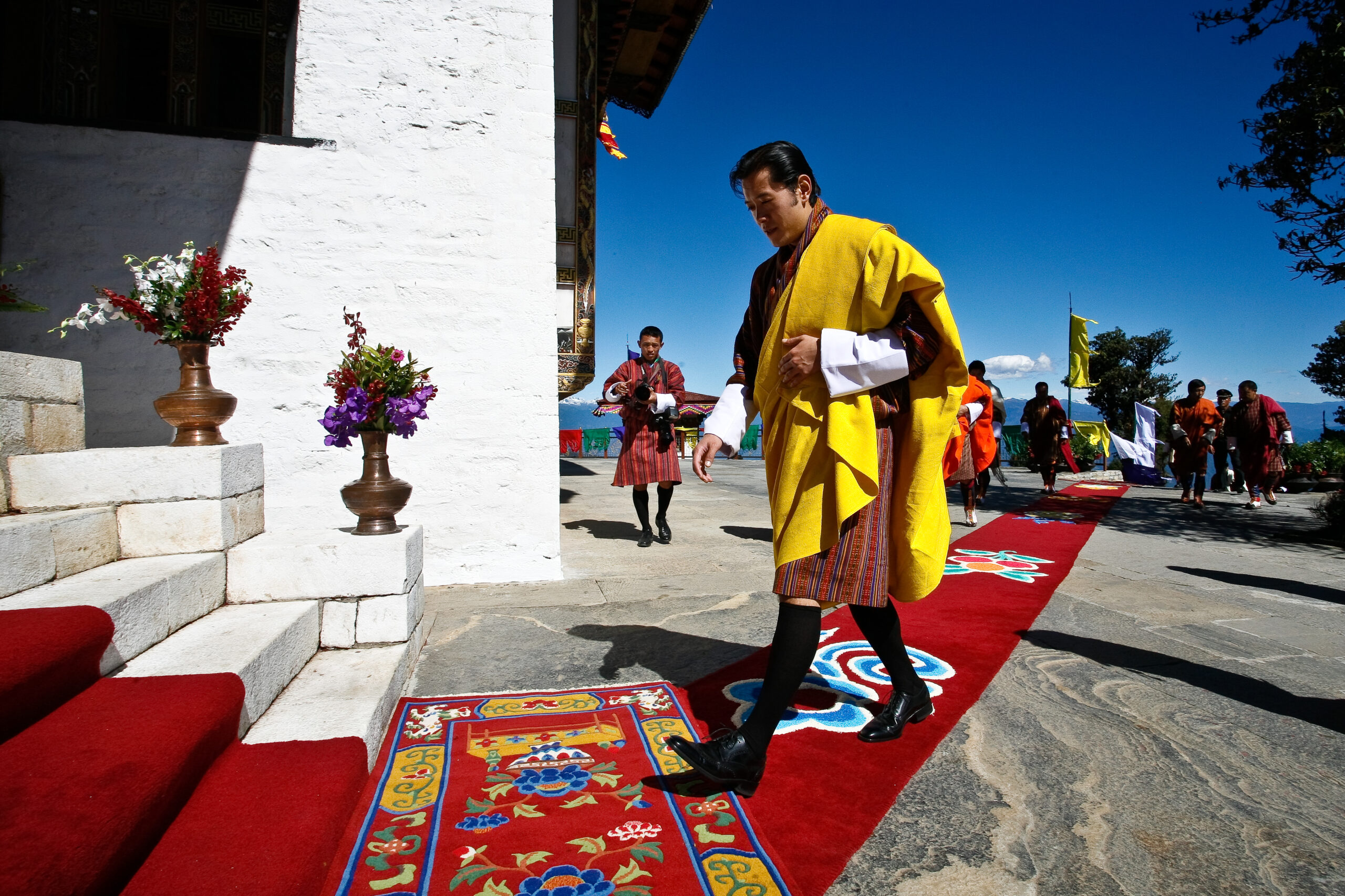
The National Dress Code, requiring citizens to wear traditional clothing (gho for men, kira for women) in public buildings and formal settings, maintains cultural distinctiveness while supporting textile artisans and weavers. This policy, upheld with royal backing, ensures continued demand for traditional skills and materials, creating economic opportunities rooted in cultural heritage. Similarly, regulations requiring traditional architecture for new buildings sustain construction techniques and aesthetic traditions while generating employment for specialized craftspeople.
The monarchy’s patronage of festivals, religious institutions, and cultural events reinforces their economic viability alongside their spiritual and social functions. Royal attendance at major festivals like Paro Tshechu and Thimphu Tshechu elevates these events, attracting both domestic participants and international visitors whose spending supports local economies. This approach transforms cultural preservation from a cost center into an economically productive activity that simultaneously fulfills spiritual, social, and material objectives.
Language policy reflects similar integration of cultural and economic considerations. While English-medium education provides access to global knowledge and opportunities, support for Dzongkha (the national language) and various regional languages maintains linguistic diversity and cultural identity. The monarchy’s multilingual communications, combining Dzongkha with English, model this balance and signal that economic modernization need not require cultural homogenization.
Managing Globalization Pressures
King Jigme Khesar’s Bhutan faces intensifying globalization pressures as digital connectivity, media access, and international travel expose citizens to alternative lifestyles and values. The monarchy plays a crucial stabilizing role in helping Bhutanese society process global influences while maintaining cultural moorings.
The King’s international engagements, including state visits, diplomatic meetings, and participation in global forums, demonstrate that cultural preservation is compatible with sophisticated international participation. His education at international institutions and evident comfort in global settings provides credibility when advocating for Bhutan’s distinctive development path. This royal example helps counter perceptions that maintaining Bhutanese identity requires isolation or backwardness.
Media and internet policy under the Fifth King’s reign has sought to balance information access with cultural protection. While avoiding heavy-handed censorship that would be inconsistent with democratic governance, policies promote local content production and digital literacy that enables critical engagement with global media. Royal messaging emphasizes thoughtful consumption of global culture rather than wholesale rejection or uncritical acceptance.
The monarchy’s response to emigration pressures exemplifies measured engagement with globalization. Rather than preventing citizens from leaving or condemning those who do, royal statements acknowledge the attractions of opportunities abroad while highlighting the unique values and quality of life Bhutan offers. This approach respects individual choice while making the case for remaining in or returning to Bhutan, trusting citizens to make informed decisions rather than coercing their loyalty.
Environmental Sustainability and Economic Development
Bhutan’s constitutional requirement to maintain at least 60 percent forest coverage reflects the deep integration of environmental protection into national identity and policy. Under King Jigme Khesar, this commitment has been maintained even as economic development accelerates, demonstrating that monarchical institutions can enforce long-term environmental priorities against short-term economic pressures.
The carbon-negative status that Bhutan has achieved, absorbing more carbon dioxide than it emits, represents a remarkable accomplishment given ongoing development. This achievement stems from extensive forest coverage, limited industrial development, and hydropower-based energy generation. The monarchy’s consistent messaging that environmental preservation is non-negotiable helps maintain political will for conservation policies even when they constrain economic options.
Climate change poses particular risks for Bhutan given its Himalayan geography, glacier-dependent water resources, and vulnerable mountain ecosystems. The King has prioritized climate adaptation and mitigation in development planning, supporting international climate advocacy while pursuing domestic resilience measures. This royal leadership ensures climate considerations inform infrastructure design, agricultural policy, and disaster preparedness, protecting long-term sustainability even if requiring higher upfront costs.
Organic agriculture initiatives promoted under royal patronage represent environmental sustainability converging with economic opportunity. Bhutan’s goal of becoming fully organic in agricultural production positions the country to access premium markets for organic products while protecting soil health and water quality. Though implementation challenges remain, particularly regarding yield impacts and certification costs, the vision demonstrates commitment to development pathways that enhance rather than degrade natural systems.